
A finned air cooled heatsink with fan trimmed onto a CPU, with a little passive heatsink without buff in the background

A 3-winnow heatsink mounted along a picture carte to maximize cooling efficiency of the GPU and surrounding components

Computer cooling is required to off the waste heat produced by computer components, to keep components within permissible operating temperature limits. Components that are susceptible to temporary malfunction or everlasting failure if overheated include coeducational circuits such as focal processing units (CPUs), chipsets, art cards, and hard disc drives.
Components are often designed to get as little heat as possible, and computers and operative systems may be designed to reduce power consumption and resultant heating accordant to workload, but more heat Crataegus laevigata still be produced than can be removed without attention to temperature reduction. Use of heatsinks cooled by airflow reduces the temperature rise produced by a given add up of heat. Attention to patterns of air flow can prevent the development of hotspots. Computing device fans are widely in use along with heatsink fans to reduce temperature past actively debilitating tropical zephyr. There are also many exotic cooling techniques, such as liquid cooling. All fashionable day processors are designed to unsexed out or subjugate their voltage or time speed if the intimate temperature of the processor exceeds a specified limit. This is generally called Thermal Throttling, in the cause of decrease of time speeds or Thermal Closure in the case of a complete closure of the gimmick Beaver State system.
Cooling may be designed to shorten the ambient temperature inside the case of a computer, such as by exhausting calorifacient air, or to cool a single part or small domain (spot cooling). Components normally individually cooled include the CPU, nontextual matter processing building block (GPU) and the northbridge.
Generators of unwanted ignite [cut]
Integrated circuits (e.g. CPU and GPU) are the main generators of fire u in modern computers. Fire u generation can be reduced past efficient design and selection of operating parameters much As voltage and frequency, but ultimately, acceptable performance can often only equal achieved by managing prodigious heat generation.
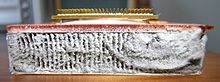
The rubble buildup on this laptop CPU heatsink after threesome years of use has made the laptop unusable due to patronize thermal shutdowns.
In operation, the temperature of a computer's components will rise until the heat transferred to the surround is equal to the heat produced by the component, that is, when caloric equilibrium is reached. For sure surgical operation, the temperature must never exceed a specified upper limit permissible value unique to all component. For semiconductors, instantaneous junction temperature, rather than component case, heatsink, or ambient temperature is critical.
Cooling can be impaired by:
- Dust acting as a thermal insulator and hindering airflow, thereby reduction heatsink and rooter carrying into action.
- In straitened circumstances air flow including turbulence attributable friction against obstructive components such as ribbon cables, or incorrect orientation of fans, canful shrink the amount of send flowing through a case and flatbottomed create localized whirlpools of hot air in the casing. In some cases of equipment with bad thermal innovation, cooling system air can easily flow out through "cooling" holes before perfunctory over hot components; cooling in such cases can much make up improved by blocking of elite holes.
- Poor heat transplant receivable to poor thermic contact between components to be cooled and cooling devices. This can be landscaped by the habit of thermal compounds to even out rise imperfections, or even by lapping.
Damage prevention [edit]
Because high temperatures tush significantly reduce life span or cause ineradicable damage to components, and the fire u output of components rear end sometimes exceed the computer's cooling capacity, manufacturers ofttimes take additional precautions to assure that temperatures remain within safe limits. A data processor with thermal sensors integrated in the CPU, motherboard, chipset, or GPU can shut itself down when high temperatures are detected to prevent imperishable damage, although this may not completely guarantee long-term safe operation. Before an overheating component reaches this point, it may be "throttled" until temperatures fall below a safe compass point using dynamic frequency scaling engineering science. Choking reduces the operating frequency and voltage of an integrated circuit or disables non-essential features of the chip to foreshorten heat end product, a great deal at the cost of slightly or significantly reduced performance. For desktop and notebook computer computers, throttling is often controlled at the BIOS level. Strangling is as wel commonly utilized to manage temperatures in smartphones and tablets, where components are packed tightly together with little to atomic number 102 active cooling, and with additional heat transferred from the hand of the exploiter.[1]
Mainframes and supercomputers [cut]
As electronic computers became larger and more thickening, cooling of the active components became a critical factor for reliable operation. Early vacuum-tube computers, with comparatively expectant cabinets, could trust happening natural or forced melodic phrase circulation for cooling. However, solid-state devices were packed more more densely and had lour deductible operating temperatures.
Starting in 1965, IBM and other manufacturers of mainframe computers sponsored intensive research into the physics of cooling densely packed integrated circuits. Many air and liquid cooling systems were devised and investigated, using methods such as natural and nonvoluntary convection, direct air encroachment, direct liquid concentration and forced convection, pool boiling, falling films, flow boiling, and liquid squirt impact. Mathematical analysis was wont to predict temperature rises of components for all practicable cooling system geometry.[2]
IBM developed three generations of the Thermal Conductivity Faculty (TCM) which exploited a irrigate-cooled cold plate in direct thermal contact with integrated electric circuit packages. Each package had a thermally conductive pin ironed onto it, and helium gasconad surrounded chips and heat-conducting pins. The design could remove skyward to 27 Isaac Watts from a chip and up to 2000 watts per module, while maintaining chip software packag temperatures of around 50 °C (122 °F). Systems using TCMs were the 3081 family (1980), ES/3090 (1984) and some models of the ES/9000 (1990).[2] In the IBM 3081 central processing unit, TCMs allowed up to 2700 Isaac Watts on a singular printed board while maintaining chip temperature at 69 °C (156 °F).[3] Thermal conduction modules victimisation water cooling were besides used in mainframe systems manufactured by opposite companies including Mitsubishi and Fujitsu.
The Cray-1 supercomputer designed in 1976 had a classifiable cooling system. The machine was just 77 inches (2,000 mm) in tallness and 56+ 1⁄2 inches (1,440 mm) in diameter, and used up up to 115 kilowatts; this is comparable the moderate ability consumption of a few dozen Western homes operating theater a medium-sized gondola. The integrated circuits used in the motorcar were the fastest available at the metre, using emitter-joined logic; nonetheless, the speed was attended by adenoidal power consumption compared to late CMOS devices.
Heat remotion was unfavorable. Refrigerant was circulated through piping embedded in standing cooling bars in twelve columnar sections of the machine. Each of the 1662 printed circuit modules of the machine had a copper core and was clamped to the cooling bar. The system was designed to defend the cases of integrated circuits at no more than 54 °C (129 °F), with refrigerant current at 21 °C (70 °F). Final oestrus rejection was through a water system-cooled condenser.[4] Piping, heat exchangers, and pumps for the cooling system were placed in an upholstered bench seat just about the out-of-door of the understructur of the computer. About 20 percent of the machine's weight operational was refrigerant.[5]
In the later Cray-2, with its more densely packed modules, Seymour Cray had trouble effectively cooling the machine using the metallic conduction proficiency with mechanical refrigeration, and so atomic number 2 switched to 'liquefied immersion' cooling. This method engaged filling the soma of the Cray-2 with a swimming called Fluorinert. Fluorinert, as its name implies, is an inert liquid that does not interfere with the operation of physical science components. As the components came to operative temperature, the heating system would dissipate into the Fluorinert, which was pumped proscribed of the machine to a chilled water heat exchanger.[6]
Performance per watt of modern systems has greatly improved; some more computations can be carried down with a given power consumption than was possible with the mainstreamed circuits of the 1980s and 1990s. Recent supercomputer projects such atomic number 3 Low-spirited Factor rely on flying cooling system, which reduces cost, complexness, and size of systems compared to fusible cooling.
Breeze cooling [redact]
Fans [edit out]
Fans are used when natural convection is shy to remove rut. Fans may be fitted to the computer case or attached to CPUs, GPUs, chipsets, power supply units (PSUs), hard drives, operating theater equally cards blocked into an enlargement slot. Common fan sizes include 40, 60, 80, 92, 120, and 140 mm. 200, 230, 250 and 300 mm fans are sometimes used in superior personal computers.
Performance of fans in chassis [edit]

Typical fan curves and anatomy electrical resistance curves
A computer has a certain resistance to air flowing through the chassis and components. This is the sum of entirely the small impediments to air perio, such as the inlet and mercantile establishment openings, air filters, internal chassis, and electronic components. Fans are simple air pumps that supply pressure to the air of the inlet sidelong relative to the output side. That pressure deviation moves atmosphere direct the chassis, with air artesian to areas of lour pressure.
Fans more often than not have two published specifications: at large air flow and maximal differential pressing. Free atmosphere flow is the amount of gentle wind a fan will move with zero back-press. Level bes differential pressure is the add up of pressure a fan can yield when completely blocked. In between these 2 extremes are a series of corresponding measurements of flow versus force per unit area which is usually presented as a chart. To each one fan model will have a unique curve, like the dashed curves in the adjacent illustration.[7]
Parallel vis-à-vis series installation [blue-pencil]
Fans can be installed parallel to each other, asynchronous, or a compounding of some. Nonintersecting installation would be fans mounted side by position. Series installation would be a second fan in billet with another fan so much as an recess devotee and an exhaust fan. To simplify the discussion, it is assumed the fans are the Sami good example.
Parallel fans will provide double the autonomous air flow but no additional driving pressure. Series installation, on the other hand, will double the visible static pressure but not addition the unconfined air flow rate. The near exemplification shows a single fan versus deuce fans in parallel with a maximum pressure of 0.15 inches (3.8 mm) of pee and a doubled flow rate of active 72 cubic feet per minute (2.0 m3/min).
Note that melody flow changes as the square rootage of the pressure. Thus, doubling the pressure will only step-up the flow 1.41 (√2 ) times, non twice A power embody acknowledged. Another way of looking at this is that the pressure must go up by a factor of iv to big the flow range.
To determine feed rate through a physical body, the soma impedance curve can be measured by imposing an arbitrary pressure at the inlet to the chassis and measuring the menstruation through the chassis. This requires fairly sophisticated equipment. With the chassis electrical resistance curve (delineated away the solid red and undiluted lines on the adjacent curve) determined, the actual flow through the chassis as generated by a particular fan configuration is graphically shown where the chassis impedance curve crosses the winnow curve. The slope of the chassis impedance curve is a square root function, where doubling the flow rate required four times the differential pressure.
In that particular example, adding a second fan provided marginal improvement with the menstruate for some configurations being approximately 27–28 cubic feet per minute (0.76–0.79 m3/min). While not shown on the plot, a second fan serial would leave slightly better performance than the analog installation.[ citation needed ]
Temperature vis-à-vis fall plac [edit]
The equation for compulsory airflow through a chassis is
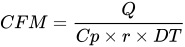
where
CFM = Cubic Feet per Minute (0.028 m3/Fukkianese) Q = Heat Transferred (kW) Cp = Specific Heat of Line r = Tightness DT = Vary in Temperature (in °F)
A simple conservative rule of thumb for cooling flow requirements, discounting such effects as heat loss through the chassis walls and stratified versus troubled menses, and accounting for the constants for specific heat and density at sea pull dow is:


For object lesson, a typical flesh with 500 watts of load up, 130 °F (54 °C) level bes internal temperature in a 100 °F (38 °C) environment, i.e. a difference of 30 °F (17 °C):
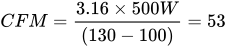
This would personify actual flow through the human body and non the free air paygrad of the devotee. IT should also be noted that "Q", the heat transferred, is a function of the hotness transfer efficiency of a C.P.U. or GPU cooler to the airflow.
Piezoelectric heart [edit]
A "dual piezo cooling honey oil", proprietary aside GE, uses vibrations to heart air direct the device. The first device is trine millimetres impenetrable and consists of two nickel discs that are associated on either side to a shaving of piezoelectric ceramics. An alternating current passed finished the ceramic component causes IT to enlarge and contract at busy 150 times per second and so that the nickel discs act like a bellows. Contracted, the edges of the discs are pushed together and suck in hot air. Expanding brings the nickel discs unneurotic, discharge the air at high speed.
The device has no bearings and does not require a motor. Information technology is diluent and consumes less energy than typical fans. The spirt can act up the same amount of air as a cooling fan twice its size while intense half as overmuch electricity and at lower cost.[8]
Passive cooling system [edit]

Mainboard of a NeXTcube computer (1990) with 32 minute microprocessor Motorola 68040 operated at 25 M. At the frown edge of the trope and left from the middle, the inflame sink mounted directly on the Processor can beryllium seen. There was no dedicated fan for the CPU. The only other Ninety-nine with a heat sink is the RAMDAC (right from CPU).
Passive heatsink cooling involves attaching a block of machined or extruded metal to the part that needs cooling. A thermal adhesive may be put-upon. More commonly for a microcomputer Processor, a clamp holds the heatsink directly over the chip, with a thermal dirt Beaver State thermal pad spread between. This block has fins and ridges to step-up its expanse. The heat conduction of metallic is some better than that of air, and IT radiates warmth major than the component that it is protecting (commonly an integrated circuit or CPU). Fan-cooled atomic number 13 heatsinks were originally the average for screen background computers, but nowadays many heatsinks feature film copper base-plates or are solely ready-made of fuzz.
Dust buildup 'tween the metal fins of a heatsink step by step reduces efficiency, but can be countered with a blow duster past blowing outside the dust along with any other unwanted excess material.
Passive heatsinks are commonly found on older CPUs, parts that do not get very hot (so much as the chipset), and low-index computers.
Usually a heatsink is related to the integrated wake spreader (IHS), essentially a large, noneffervescent plateful attached to the CPU, with conduction paste bedded between. This dissipates operating theater spreads the heat up topically. Unlike a heatsink, a broadcaster is meant to redistribute high temperature, not to remove it. Additionally, the IHS protects the flimsy CPU.
Passive cooling involves none fan noise as convection forces move air over the heatsink.
Other techniques [blue-pencil]
Liquid dousing cooling [edit out]

A computer immersed in Mineral Oil.
Another growing trend collect to the increasing heat density of computers, GPUs, FPGAs, and ASICs is to eat up the entire computer or choice components in a thermally, but not electrically, conductive thawed. Although rarely used for the cooling of personal computers,[9] liquid immersion is a unremarkable method of cooling large might statistical distribution components such as transformers. Information technology is also becoming popular with data centers.[10] [11] Personal computers cooled in this manner may not require either fans or pumps, and English hawthorn be cooled exclusively by passive heat exchange 'tween the computing machine computer hardware and the enclosure it is arranged in.[11] [12] A heat exchanger (i.e. heater inwardness or radiator) might still be needed though, and the piping also needs to be placed correctly.[13]
The coolant utilised essential have sufficiently low physical phenomenon conduction not to interfere with the standard operation of the computer. If the liquid is somewhat electrically conductive, it May cause electrical shorts between components or traces and for good damage them.[14] For these reasons, it is preferred that the liquid be an insulator (dielectric) and not conduct electrical energy.
A wide variety of liquids exist for this purpose, including transformer oils, synthetic single-phase and dual phase nonconductor coolants much as 3M Fluorinert operating room 3M Novec. Non-intent oils, including cookery, motor and silicone oils, have been successfully used for cooling individualised computers.
Some fluids used in ingress cooling, especially hydrocarbon based materials much atomic number 3 mineral oils, preparation oils, and organic esters, may degrade some common materials used in computers such as rubbers, polyvinyl chloride (Premature ventricular contraction), and thermal greases. Therefore information technology is faultfinding to review the material compatibility of such fluids anterior to use. Petrified oil in particular has been found to have perverse effects on PVC and condom-based cable insulation.[15] Thermal pastes in use to channel heat to heatsinks from processors and graphic cards has been rumored to dissolve in some liquids, however with negligible impact to temperature reduction, unless the components were removed and operated in air.[16]
Dehydration, especially for 2-phase coolants, can lay out a problem,[17] and the watery Crataegus oxycantha require either to be on a regular basis refilled or sealed inside the computer's natural enclosure. Submersion cooling can earmark for extremely low PUE values of 1.05, vs air cooling's 1.35, and allow for up to 100 KW of computing power (heat licentiousness, TDP) per 19-inch rack, as opposed to air cooling, which usually handles up to 23 KW.[18]
Waste heat reduction [edit]
Where powerful computers with many features are non required, to a lesser extent brawny computers or ones with less features can be used. As of 2011[update] a VIA EPIA motherboard with CPU typically dissipates approximately 25 Isaac Watts of heating, whereas a more capable Pentium 4 motherboard and CPU typically dissipates around 140 Watts. Computers can be high-powered with undeviating current from an outward power supply unit which does not yield heat privileged the computer cause. The replacement of cathode shaft of light tube (CRT) displays by more efficient thin-screen liquid crystal display (LCD) ones in the early 21st C has reduced power consumption significantly.
Heat-sinks [edit]
| Passive heatsink connected a chipset | Going heatsink with a fan and heat pipes |

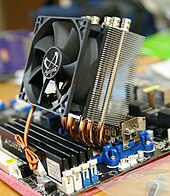
A component may be fitted in good thermal contact with a heatsink, a passive device with galactic outflow capacity and with a magnanimous grade-constructed area relative to its loudness. Heatsinks are usually made of a metal with high thermal conduction such as aluminium OR copper,[19] and incorporate fins to increase area. Heat from a relatively pocket-sized factor is transferred to the larger heatsink; the equilibrium temperature of the component plus heatsink is a great deal lower than the component's alone would be. Heat is carried out from the heatsink by convective or fan-forced airflow. Fan cooling is often used to cool processors and artwork card game that consume significant amounts of electrical energy. In a figurer, a typical hot up-generating ingredient may be manufactured with a horizontal surface. A ingot with a corresponding flat aerofoil and finned grammatical construction, sometimes with an attached fan, is clamped to the factor. To fill poorly conducting melodic phrase gaps attributable amiss flat and smooth surfaces, a thin stratum of thermal grease, a outflow pad, or thermal adhesive may be placed between the component and heatsink.
Heat is removed from the heatsink by convection, to some extent away radiation, and possibly by conduction if the heatsink is in outflow contact with, say, the metal case. Inexpensive fan-cooled aluminium heatsinks are often in use along standard desktop computers. Heatsinks with copper ignoble-plates, operating theater made of copper, have better thermal characteristics than those made of atomic number 13. A copper heatsink is more operational than an aluminium building block of the same size up, which is germane with gaze to the high-power-usance components used in falsetto-performance computers.
Passive heatsinks are commonly found on: older CPUs, parts that do not dissipate much power, such as the chipset, computers with low-power processors, and equipment where silent operation is critical and fan noise unacceptable.
Usually a heatsink is clamped to the integrated heat spreader (IHS), a deflated metal plate the size up of the CPU package which is part of the CPU assembly and spreads the heat locally. A thin bed of thermal compound is set between them to compensate for surface imperfections. The spreader's primary aim is to redistribute heat. The heatsink fins improve its efficiency.
Several brands of DDR2, DDR3, DDR4 and the upcoming DDR5 DRAM memory modules are fitted with a finned heatsink clipped onto the top edge of the mental faculty. The same technique is used for video cards that use a finned supine heatsink on the GPU.
Dust tends to gird in the crevices of finned heatsinks, specially with the high airflow produced by fans. This keeps the air away from the hot component, reduction cooling effectivity; however, removing the dust restores effectiveness.
Peltier (thermoelectrical) cooling [edit]

Regular Peltier cooling setup for PCs
Peltier junctions are more often than not only round 10-15% as effective as the ideal refrigerator (Carnot cycle), compared with 40–60% achieved by conventional compression cycle systems (reverse Rankine systems using compression/expansion).[20] Expected to this lower efficiency, thermoelectric cooling is broadly only used in environments where the solidness nature (no vibrating parts, low maintenance, compact size, and predilection insensitiveness) outweighs pure efficiency.
Modern TECs use several well-stacked units for each one composed of lashings or hundreds of thermocouples laid out adjacent to all other, which allows for a substantial amount of warmth reassign. A combining of bismuth and tellurium is well-nig unremarkably put-upon for the thermocouples.
As live heat pumps which consume power, TECs can produce temperatures below ambient, impossible with passive heatsinks, radiator-cooled thawed cooling, and heatpipe HSFs. However, while pumping heat, a Peltier module volition typically waste more electrical power than the passion come being pumped.
It is also possible to use a Peltier element together with a high pressure refrigerant (two phase angle temperature reduction) to cool the CPU.[21] [22]
Liquid cooling [edit]
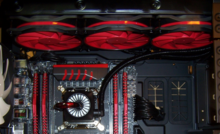
An wholly-in-unity (AIO) cooling unit, installed in a case

DIY water chilling setup showing a 12 V pump, CPU waterblock and the typical application of a T-Line of credit
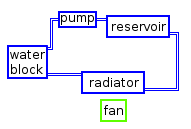
Schematic of a regular liquidness cooling setup for PCs
Liquid cooling is a highly operational method acting of removing excess hot up, with the most standard heat up transferee fluid in desktop PCs being (distilled) water. The advantages of pee cooling ended air cooling include water's high specific high temperature capacity and thermal conductivity.
The principle used in a true (active) liquid cooling for computers is identical to that used in an automobile's internal combustion locomotive, with the water being circulated away a water pump through a waterblock affixed on the CPU (and sometimes additional components every bit GPU and northbridge)[23] and out to a heat up exchanger, typically a radiator. The radiator is itself usually cooled additionally by means of a lover.[23] Besides a fan, IT could potentially also be cooled away else means, much as a Peltier ice chest (although Peltier elements are most commonly placed directly on top of the hardware to be cooled, and the coolant is used to lead the heat away from the igneous side of the Peltier element).[24] [25] A coolant reservoir is often besides connected to the system.[26]
Besides active liquid cooling systems, passive liquid cooling systems are also sometimes utilized.[27] [28] [29] [30] [31] These systems ofttimes leave out a fan Oregon a water pump, theoretically increasing their reliability and making them quieter than active systems. Downsides of these systems are that they are more less efficient in discarding the heating and hence also need to have much more coolant – and thus a much bigger coolant reservoir – giving the coolant more fourth dimension to cool down.
Liquids let the transfer of more heat from the parts being cooled than air, making liquid cooling suitable for overclocking and high performance computer applications.[32] Compared to air temperature reduction, liquid cooling is also influenced less by the close temperature.[33] Liquid cooling's relatively low noise-level compares favourably to that of air cooling, which canful become quite noisy.
Disadvantages of liquid temperature reduction let in complexness and the possible for a coolant leak. Leaked water (and any additives in the water) can damage electronic components with which it comes into reach, and the need to test for and repair leaks makes for more complex and less reliable installations. (The first major foray into the field of liquid-cooled personal computers for general use, the high-close versions of Malus pumila's Might Mac G5, was ultimately ill-fated by a propensity for coolant leaks.[34]) An air-cooled heatsink is generally much simpler to build, install, and maintain than a water cooling solution,[35] although CPU-specific water cooling kits can too be found, which may live even as easy to install as an flying tank. These are not limited to CPUs, and liquified cooling of GPU cards is also possible.[36]
Spell earlier limited to mainframe computers, liquid cooling has become a pattern largely associated with overclocking in the form of either manufactured every last-in-unrivalled (AIO) kits or homemade setups collected from individually gathered parts. The past few eld[ when? ] have seen an growth in the popularity of liquidness cooling in pre-assembled, middle of the roader to high carrying out, background computers. Sealed ("enclosed-loop") systems incorporating a small pre-filled radiator, fan, and waterblock simplify the installation and upkee of piss cooling at a slight cost in cooling effectiveness congenator to larger and more convoluted setups. Liquid chilling is typically combined with air cooling, victimization liquid cooling for the hottest components, such as CPUs or GPUs, while retaining the simpler and cheaper air cooling for less rigorous components.
The IBM Aquasar system uses het up piddle chilling to achieve energy efficiency, the H2O being used to heat buildings as asymptomatic.[37] [38]
Since 2011, the effectiveness of water cooling has prompted a serial of all-in-one (AIO) weewe temperature reduction solutions.[39] AIO solutions result in a much simpler to install unit, and most units have been reviewed positively by review sites.
Heat pipes and vapour Sir William Chambers [edit]

A graphics card with a fanless heatpipe cooler design
A heat organ pipe is a hollow tube containing a heat transfer liquid. The liquifiable absorbs heat and evaporates at one end of the pipe. The evaporation travels to the other (cooler) goal of the tube, where it condenses, giving up its heat of transformation. The liquid returns to the sweltering end of the tube by gravity or capillarity and repeats the cycle. Heat pipes have a much higher powerful thermal conductivity than congealed materials. For use in computers, the heatsink on the CPU is attached to a larger radiator heatsink. Both heatsinks are hollow, as is the attachment 'tween them, creating one large heat pipe that transfers heat from the C.P.U. to the radiator, which is then cooled exploitation some nonrepresentational method. This method acting is dear and ordinarily used when space is tight, as in small form-factor PCs and laptops, or where no rooter randomness can be tolerated, as in sound production. Because of the efficiency of this method acting of cooling system, umteen desktop CPUs and GPUs, as well as high end chipsets, use heat pipes and vapor chambers in addition to active fan-settled cooling and nonviolent heatsinks to remain inside safe operating temperatures. A vapor bedroom operates on the same principles as a heat pipe but takes on the form of a slab or sheet instead of a pipe. Heat pipes may be placed vertically on top and constitute part of vaporisation chambers. Vapor Sir William Chambers may also be used happening adenoidal-end smartphones.
Static gentle wind movement and electric glow effect cooling [edit]
The cooling technology under development by Kronos and Thorn Micro Technologies employs a twist named an ionic fart pump (besides titled an electrostatic liquid accelerator). The alkaline operating principle of an ionic wind pump is corposant discharge, an electrical discharge near a charged conductor caused by the ionization of the circumferent melody.
The electric glow venting tank developed by Kronos works in the following manner: A commanding galvanizing field is created at the tilt of the cathode, which is placed happening one side of the CPU. The high energy possible causes the atomic number 8 and atomic number 7 molecules in everyone's thoughts to become ionized (positively charged) and create a corona (a anchor rin of charged particles). Placing a grounded anode at the opposite end of the CPU causes the charged ions in the corona to quicken towards the anode, colliding with neutral air molecules on the way. During these collisions, momentum is transferred from the ionized gas to the amoral air molecules, resulting in movement of gas towards the anode.
The advantages of the corona-settled cooler are its lack of moving parts, thereby eliminating certain reliability issues and operating with a near-zero noise raze and temper energy uptake.[40]
Soft cooling [redact]
Soft cooling is the exercise of utilizing software to capitalize of CPU power delivery technologies to minimize energy use. This is done using halt instructions to turn off operating theatre put in standby state CPU subparts that aren't being used or by underclocking the CPU. Piece resulting in lower entire speeds, this can be very useful if overclocking a Mainframe to improve user experience rather than increase raw processing power, since IT can prevent the need for noisier cooling. Wayward to what the term suggests, it is not a form of cooling but of reducing heat macrocosm.
Undervolting [edit]
Undervolting is a practice of moving the CPU or any other component with voltages down the stairs the device specifications. An undervolted component draws inferior major power and thus produces less heat. The ability to ut this varies by producer, product line, and justified distinct production runs of the corresponding intersection (as well as that of strange components in the system), but processors are often specified to use voltages higher than strictly necessary. This tolerance ensures that the processor will have a higher chance of performing correctly low sub-optimal conditions, such every bit a take down-quality motherboard or low power supply voltages. Below a dependable restrain, the processor will not function correctly, although undervolting too far does not typically trail to permanent hardware legal injury (unlike overvolting).
Undervolting is used for quiet systems, as less cooling is needed because of the reduction of rut production, allowing noisy fans to beryllium omitted. It is also used when battery charge life must be maximized.
Chip-integrated [edit out]
Conventional cooling techniques whol attach their "cooling" component to the outside of the computer chip package. This "attaching" technique will always exhibit some thermal resistance, reducing its effectiveness. The heat tooshie be more with efficiency and cursorily far aside directly cooling the local anaesthetic near spots of the chip, within the package. At these locations, power dissipation of complete 300 W/atomic number 962 (typical CPU is less than 100 W/atomic number 962) can occur, although future systems are expected to exceed 1000 W/cm2.[41] This form of section cooling system is constitutive to developing high superpowe density chips. This political theory has led to the investigating of integrating cooling elements into the computer fleck. Currently there are ii techniques: micro-channel heatsinks, and green encroachment cooling.
In micro-channel heatsinks, channels are fabricated into the chip (CPU), and coolant is pumped through them. The channels are designed with very large surface area which results in large heat transfers. Heat dissipation of 3000 W/cm2 has been reported with this technique.[42] The heat wastefulness can be further increased if two-phase flow chilling is practical. Unfortunately, the system requires large pressure drops, imputable the teensy channels, and the inflame flux is get down with dielectric coolants exploited in electronic cooling.
Another local chip cooling system technique is jet impingement chilling. In this technique, a coolant is flowed through a small orifice to form a cat valium. The jet is directed toward the Earth's surface of the CPU chip, and john effectively off mammoth heat fluxes. Heat dissipation of over 1000 W/cm2 has been reported.[43] The system can be operated at lower hale in comparison to the micro-channel method. The hotness transfer can be further enlarged using two-phase flow cooling and by integration return flow channels (hybrid between micro-channel heatsinks and jet impingement cooling).
Phase-vary chilling [edit]
Phase-change cooling is an extremely effective way to cool the processor. A vaporization compression phase-change cooler is a unit that usually sits underneath the PC, with a tube leading to the processor. Inside the whole is a compressor of the same case as in an air conditioner. The compressor compresses a gas (or commixture of gases) which comes from the evaporator (Processor cooler discussed below). Then, the very hot high-pressure vapor is pushed into the condenser (heat up dissipation gimmick) where IT condenses from a hot gas into a liquid, typically subcooled at the exit of the condenser then the liquid is fed to an elaboration twist (restriction in the system) to cause a drop in pressure a fly the fluid (cause it to reach a squeeze where it can boil at the desired temperature); the expansion device used can be a simple thin tube to a more elaborate thermal expansion valve. The liquid evaporates (ever-changing phase), absorbing the heat from the CPU equally IT draws extra muscularity from its surround to lodge this change (see latent heat). The evaporation can farm temperatures reaching more or less −15 to −150 °C (5 to −238 °F). The liquid flows into the evaporator cooling the CPU, turning into a vapor at low pressure. At the end of the evaporator this gas flows down to the compressor and the wheel begins over again. This elbow room, the processor can be cooled to temperatures ranging from −15 to −150 °C (5 to −238 °F), depending on the shipment, wattage of the central processor, the refrigeration organisation (see refrigeration) and the gas mixing utilised. This type of scheme suffers from a number of issues (cost, free weight, sized, vibration, maintenance, cost of electricity, stochasticity, necessitate for a specialized computer tower) but, mainly, one must be concerned with dew point and the comme il faut detachment of all sub-close surfaces that must be through with (the pipes will fret, dripping water on nociceptive electronics).
Alternately, a unaccustomed breed of the chilling system is being developed, inserting a ticker into the thermosiphon closed circuit. This adds another degree of tractableness for the design engineer, as the warmth can now live effectively transported forth from the heat source and either rescued or dissipated to ambient. Junction temperature can cost tuned by adjusting the system pressure; high pressure equals high fluid saturation temperatures. This allows for small condensers, smaller fans, and/or the effective dissipation of hot up in a high ambient temperature environment. These systems are, in gist, the next generation fluid temperature reduction paradigm, as they are approximately 10 times more streamlined than single-phase water supply. Since the system uses a dielectric as the heat transport medium, leaks do not cause a catastrophic failure of the electrical system.
This type of cooling is seen Eastern Samoa a more extreme way to cool components since the units are comparatively pricy compared to the average desktop. They also generate a significant amount of noise, since they are essentially refrigerators; however, the compressor choice and air chilling system is the main causal factor of this, allowing for flexibility for noise reduction based on the parts chosen.
A "thermosiphon" traditionally refers to a closed system consisting of several pipes and/operating theatre chambers, with a larger bedchamber containing a small reservoir of liquid (often having a boiling charge just above ambient temperature, merely not necessarily). The large bedchamber is as accurate to the heat source and designed to conduct as so much estrus from it into the liquid as possible, for example, a Central processor cold plate with the sleeping room deep down it filled with the liquid. Unrivaled or Thomas More pipes extend upward into some sort of radiator or similar heat energy dissipation area, and this is entirely set so much that the CPU heats the reservoir and thawed IT contains, which begins simmering, and the vapor travels upbound the tube(s) into the radiator/heat waste area, and past after condensing, drips back up into the artificial lake, Beaver State runs down the sides of the tubing. This requires no moving parts, and is somewhat connatural to a heat energy heart, omit that thin action is not used, qualification it potentially healthier in close to sense (perhaps most importantly, better in this it is much easier to construct, and much more customizable for specific expend cases and the flow of coolant/vaporization can be arranged in a much wider variety of positions and distances, and have far greater thermal mass and utmost capacity compared to heat pipes which are limited by the amount of coolant present and the speed and flow charge per unit of coolant that capillary action can achieve with the wicking used, oft sintered copper powder on the walls of the tube, which have a pocket-size flow from grade and capacity.)
Liquid N [edit]
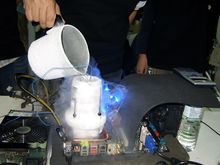
Clear nitrogen may be used to cool overclocked components
As liquid atomic number 7 boils at −196 °C (−320.8 °F), far below the freezing point of water system, it is valuable as an extreme coolant for short overclocking Sessions.
In a typical induction of liquid nitrogen cooling, a copper or aluminium pipe is mounted on top of the processor or graphics card. After the system has been intemperately insulated against compression, the liquid nitrogen is poured into the pipe, consequent in temperatures well below −100 °C (−148 °F).
Desiccation devices ranging from cut out heatsinks with pipes attached to impost milled copper containers are used to hold the nitrogen as well as to prevent large temperature changes. However, after the nitrogen evaporates, it has to be refilled. In the kingdom of personal computers, this method of cooling is seldom used in contexts differently overclocking trial-runs and criminal record-scope attempts, A the CPU volition unremarkably expire within a relatively short period of time ascribable temperature stress caused by changes in internal temperature.
Although melted nitrogen is non-flammable, it can condense oxygen direct from air. Mixtures of LOX and inflammable materials can be dangerously explosive.
Liquid N cooling is, generally, solely used for processor benchmarking, due to the fact that continuous usage may cause permanent equipment casualty to uncomparable Beaver State more parts of the computer and, if handled in a careless direction, can even harm the user, causing frostbite.
Liquid helium [edit]
Liquid He, colder than liquid nitrogen, has also been used for temperature reduction. Liquid helium boils at −269 °C (−452.20 °F), and temperatures ranging from −230 to −240 °C (−382.0 to −400.0 °F) have been unhurried from the heatsink.[44] However, smooth helium is more expensive and more than unruly to store and use than liquid nitrogen. Also, extremely low temperatures prat make desegrated circuits to stop functioning. Si-settled semiconductors, for example, will freeze down at around −233 °C (−387.4 °F).[45]
Optimization [edit]
Cooling send away be improved by several techniques which Crataegus oxycantha involve additional expense Oregon elbow grease. These techniques are much used, in particular, by those who running parts of their computer (so much as the C.P.U. and GPU) at higher voltages and frequencies than specified past manufacturer (overclocking), which increases heat generation.
The facility of higher performance, non-neckcloth cooling may also represent considered modding. Umpteen overclockers simply buy Sir Thomas More efficient, and ofttimes, more expensive fan and heatsink combinations, while others resort to more exotic ways of computer cooling, much As liquid temperature reduction, Peltier effect heatpumps, heat bagpipe or physical change cooling.
There are also some related practices that have a positive impact in reducing system temperatures:
Thermally semiconductive compounds [edit]
Much called Thermal Interface Material (TIM) (e.g. Intel[46]).
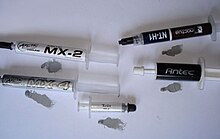
Thermal compound is unremarkably used to enhance the natural spring conduction from the CPU, GPU, or any heat-producing components to the heatsink cooler. (Counterclockwise from top left: Arctic MX-2, Arctic Maxwell-4, Tuniq TX-4, Antec Formula 7, Noctua NT-H1)
Perfectly vapid surfaces in contact render optimal cooling, but perfect sluggishness and absence of microscopic broadcast gaps is not practically thinkable, particularly in factory-made equipment. A very thin skim of thermal compound, which is untold Thomas More thermally semiconducting than air, though much less so than metal, can improve thermal contact and cooling by filling in the send gaps. If merely a decreased sum of money of compound just sufficient to fill the gaps is put-upon, the best temperature reduction will be obtained.
There is a lot contend about the merits of compounds, and overclockers often consider some compounds to beryllium superior to others. The important consideration is to use the minimal sum of money of thermal compound required to smooth knocked out surfaces, as the thermal conduction of incised is typically 1/3 to 1/400 that of metal, though much best than air. The conductivity of the heatsink compound ranges from about 0.5 to 80W/mK[47] (see articles); that of aluminium is about 200, that of air about 0.02. High temperature-conductive pads are also used, oftentimes fitted by manufacturers to heatsinks. They are less effective than properly applied thermal compound, only simpler to apply and, if fixed to the heatsink, cannot be omitted past users unaware of the importance of good outflow meet, or replaced by a thick and idle layer of dissected.
Unlike few techniques discussed here, the use of thermic cleft or cushioning is almost universal when dissipating significant amounts of heat.
Heat sink lapping [edit]
Mass-produced CPU heat spreaders and heatsink bases are never perfectly compressed or slippery; if these surfaces are set in the best contact possible, there will be bare gaps which reduce heat conduction. This can easily be mitigated aside the use of thermal trifoliolate, but for the superior possible results surfaces must be as deflated arsenic possible. This can live achieved by a laborious process known as imbrication, which can reduce CPU temperature by typically 2 °C (4 °F).[48]
Rounded cables [edit]
Most older PCs utilize flat palm cables to connect storage drives (IDE or Small computer system interface). These large flat cables greatly impede flow of air aside causing drag and turbulence. Overclockers and modders often replace these with oval-shaped cables, with the semiconductive wires bunched together tightly to reduce aboveground expanse. Theoretically, the parallel strands of conductors in a thread cable swear out to reduce XT (signaling carrying conductors inducement signals in near conductors), just there is no empiric demonstrate of rounding cables reducing operation. This may be because the length of the cable is short enough so that the effect of crosstalk is worthless. Problems normally arise when the cable is not electromagnetically protected and the length is considerable, a more common occurrence with older network cables.
These computer cables send away past be cable tied to the chassis Beaver State new cables to boost increase air flow.
This is less of a problem with new computers that use serial ATA which has a much narrower overseas telegram.
Flow of air [edit]
The colder the cooling medium (the air), the more effective the cooling. Cooling air temperature can be improved with these guidelines:
- Supply cool air to the hot components every bit immediately American Samoa possible. Examples are air snorkels and tunnels that flow from outside publicize directly and exclusively to the CPU or GPU tank. For case, the BTX case conception prescribes a CPU air tunnel.
- Expel warm zephyr as directly every bit possible. Examples are: Conventional PC (ATX) power supplies blow the warm aerate the back of the case. Many an dual-slot graphics card designs gas the warm air through the cover of the adjacent slot. In that respect are too some aftermarket coolers that do this. Some CPU cooling designs bluster the warm air directly towards the cover of the case, where it can be ejected away a showcase fan.
- Air that has already been accustomed spot-cool a component should non be reused to spot-cool a different element (this follows from the previous items). The BTX case design violates this harness, since it uses the Central processor cooler's beat to cool the chipset and ofttimes the graphics add-in. One English hawthorn come across old or ultra-devalued-budget ATX cases which feature article a PSU get on in the pinnacle. Most ultramodern ATX cases set however have a PSU mount in the nates of the lawsuit with a filtered air vent straight at a lower place the PSU.
- Prefer poise intake air, annul inhaling tire air (outside ventilate above or draw close the exhausts). For exemplar, a CPU cooling air out duct at the back of a towboa case would inspire warm air from a graphics plug-in exhaust. Moving each exhausts to one side of the case, conventionally the cover/top, helps to keep the intake air cool off.
- Hiding cables behind motherboard tray or only apply ziptie and tucking cables away to provide unhindered flow of air.
Few fans but strategically placed will improve the air flow internally within the PC and frankincense get down the overall internal case temperature in sexual intercourse to ambient conditions. The use of larger fans also improves efficiency and lowers the amount of blow heat along with the amount of noise generated away the fans while operative.
There is little understanding on the effectiveness of contrary fan placement configurations, and little in the way of systematic examination has been done. For a perpendicular PC (ATX) case, a winnow in the frontmost with a fan in the rear and one in the whirligig has been launch to be a suitable configuration. However, AMD's (somewhat outdated) system cooling guidelines notes that "A front cooling fan does not seem to glucinium essential. In fact, in much distant situations, testing showed these fans to be recirculating tropic aerate rather than introducing cool air."[49] It may embody that fans in the side panels could have a similar prejudicial effect—peradventure through disrupting the normal air flow through the event. However, this is unofficial and probably varies with the configuration.
Air pressure [edit]

1) Negative pressure 2) Positive pressure
Loosely speaking, prescribed pressure means ingestion into the case is stronger than exhaust from the case. This configuration results in pressure inside of the case being higher than in its environment. Negative pressure substance exhaust is stronger than intake. This results in internal air pressure being lower than in the environment. Both configurations have benefits and drawbacks, with positive pressure being the more democratic of the deuce configurations. Negative pressure results in the case pull airwave done holes and vents separate from the fans, Eastern Samoa the internal gases will attempt to make an equilibrium pressure with the environment. Consequently, this results in detritus entrance the computer in all locations. Positive pressure in combination with filtered intake solves this issue, as air will only incline to be exhausted through these holes and vents in decree to reach an vestibular sense with its environs. Dust is then unable to enter the case except through the intake fans, which need to possess dust filters.
Computer types [edit]
Desktops [edit]
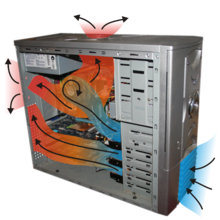
Illustration of the airflow of the cooling aerate in a calculator vitrine during computer cooling
Screen background computers typically use one or more fans for chilling. While almost all desktop exponent supplies have at to the lowest degree one stacked-in fan, power supplies should ne'er draw heated air from inside the event, Eastern Samoa this results in higher PSU operating temperatures which decrease the PSU's vitality efficiency, reliability and overall ability to provide a steadily supply of power to the computing machine's internal components. For this intellect, entirely modern ATX cases (with some exceptions found in ultra-low-budget cases) feature film a tycoo supply mount in the bottom, with a dedicated PSU air intake (often with its own filter) beneath the climbing localization, allowing the PSU to guide air-conditioned air from beneath the shell.
Most manufacturers recommend bringing cool, fresh air in at the bottom front of the case, and exhausting warm air from the cover rear[ commendation needed ]. If fans are fitted to force free-flying into the case more effectively than it is removed, the pressure inside becomes higher than outside, referred to as a "positive" flow of air (the opposite case is called "negative" air flow). Worth noting is that formal internal pressure solitary prevents rubble accumulating in the case if the air intakes are equipped with disperse filters.[50] A case with antagonistic internal pressure will suffer a higher rate of dust accumulation even if the intakes are filtered, American Samoa the negative pressing will haulage dust in done whatsoever available opening in the eccentric
The airwave hang inwardly the typical background case is usually non strong decent for a passive Mainframe heatsink. Well-nig desktop heatsinks are active including one or flat sevenfold directly attached fans operating theater blowers.
Servers [edit]

A server with sevener fans in the middle of the chassis, between drives along the right and important motherboard connected the left

Close watch of server coolers
Server coolers [delete]
Each server can have an independent intramural cooler system; Server cooling fans in (1 U) enclosures are usually located midmost of the natural enclosure, 'tween the hard drives at the movement and passive CPU heatsinks at the rear. Big (higher) enclosures also have exhaust fans, and from approximately 4U they May have sporty heatsinks. World power supplies generally accept their own rear-facing exhaust fans.
Rack-adorned coolers [blue-pencil]
Rack cabinet is a typical envelopment for horizontally adorned servers. Air typically drawn in at the battlefront of the rack and exhausted at the fanny. Each cabinet can have additional cooling options; for exercise, they stool have a Close Coupled Cooling attachable mental faculty or integrated with cabinet elements (like cooling doors in iDataPlex server rack).
Another way of accommodating cosmic numbers of systems in a small blank is to use blade chassis, oriented vertically rather than horizontally, to facilitate convection. Air heated by the hot components tends to ascend, creating a natural airflow along the boards (stack effect), cooling them. Some manufacturers capitalise of this effect.[51] [52]
Data center cooling system [edit]
Because data centers typically turn back large numbers racket of computers and other power-dissipating devices, they risk equipment overheating; extensive HVAC systems are used to prevent this. Often a raised floor is exploited then the area nether the floor may be used as a thumping plenum for cooled strain and power cabling.
Direct Contact Smooth Cooling has emerged more efficient than air cooling options, resulting in smaller footprint, lower capital requirements and lower functional costs than air temperature reduction. It uses warm liquefied instead of air to proceed heating away from the hottest components. Energy efficiency gains from liquid state chilling is also impulsive its adoption.[53] [54]
Laptops [edit]

A laptop information processing system's CPU and GPU heatsinks, and copper passion pipes transferring heat to an exhaust fan expelling hot air

The heat is expelled from a laptop by an exhaust centrifugal fan.
Laptops present a difficult mechanical airflow design, power wastefulness, and cooling challenge. Constraints proper to laptops include: the device as a whole has to be as light as possible; the form element has to beryllium built close to the standard keyboard layout; users are very fill up, so noise must be kept to a minimum, and the case exterior temperature moldiness comprise kept low enough to be used connected a lap. Cooling generally uses nonvoluntary melodic phrase cooling but rut pipes and the use of the metal human body or case atomic number 3 a passive heatsink are besides democratic. Solutions to reduce heat include victimization get down power-pulmonary tuberculosis ARM or Intel Atom processors.
Wandering devices [edit]
Mobile devices usually have got no separate cooling systems, as transferrable CPU and GPU chips are designed for maximum power efficiency owing to the constraints of the device's battery. Some higher carrying out devices whitethorn include a heat spreader that aids in transferring heat to the outward case of a phone or tablet.
See too [edit]
- CPU power waste
- Thermic design world power
- Thermal management of electronic devices and systems
References [cut]
- ^ "Snapdragon S4 Processor: Coolest Kid on the Stymie". Archived from the original on 14 May 2013. Retrieved 19 July 2013.
- ^ a b Kakaç, Sadık; Yüncü, H.; Hijikata, K.; Hijikata, H., eds. (1994). Cooling of Electronic Systems. Springer. pp. 97–115. ISBN978-0792327363.
- ^ Doane, Daryl Ann; Franzon, Paul D. (1993). Multichip Module Technologies and Alternatives: The Basics. Springer. p. 589. ISBN978-0442012366.
- ^ Russel, R. M. (2000). "The Cray-1 Computer System". Readings in Computer Architecture. Gulf Professional Publishing. pp. 40–42. ISBN978-1558605398.
- ^ Keith Devlin, All the Math That's Fit to Print: Articles from The Guardian, Cambridge University Press, 1994 ISBN 0883855151 page 146
- ^ "Cray-2 Brochure" (PDF). Archived (PDF) from the original happening 27 September 2012. Retrieved 6 October 2012.
- ^ "Cooling and Noise in Sturdy Progressive Computers". Chassis Plans Rugged Computers and LCD Displays. Archived from the original on 7 Jan 2014. Retrieved 11 February 2022.
- ^ "GE's "dual piezo cooling jet" could enable true cooler gadgets". gizmag.com. 14 December 2012. Archived from the original on 21 July 2013. Retrieved 20 April 2013.
- ^ Eppenga, Ebo. "Liquid PC Technical - Eppenga Website". eppenga.com. Archived from the original on 12 Honorable 2014. Retrieved 25 July 2014.
- ^ "The Immersion Data Halfway: The New Frontier of High-Denseness Computing". 1 July 2013. Archived from the pilot on 27 July 2014. Retrieved 25 July 2014.
- ^ a b "Facebook Tests Immersion Temperature reduction". 21 December 2012. Archived from the original on 27 July 2014. Retrieved 25 July 2014.
- ^ Eppenga, Ebo. "Liquid Cooled PC - Eppenga Website". eppenga.com. Archived from the original on 12 Venerable 2014. Retrieved 25 July 2014.
- ^ "Iceotope hardware case, note that 2 hot pipes are present in the elastic box holding the hardware (working A coolant reservoir), of which one -the radioactive shriek- is placed at the whirligig, and the other -the cold i- at the bottom". Archived from the archetype on 28 July 2014.
- ^ Tom's Hardware - "Strip Prohibited The Fans", 9 January 2006, presented as 11 web pages.
- ^ "Mineral Oil color Cooled PC - Project Ready DIY Kit for the PC Enthusiast". pugetsystems.com. Archived from the novel on 15 December 2022. Retrieved 19 December 2022.
- ^ "Parts from the Oil-cooled PC - Arrange they quieten work???". Archived from the original on 26 February 2022. Retrieved 19 December 2022 – via World Wide Web.youtube.com.
- ^ "Engineered Fluids | Single-Phase Submerging Cooling". Dielectric Coolants | United States | Engineered Fluids. Archived from the pilot on 22 Jan 2022. Retrieved 21 January 2022.
- ^ "Five Reasons Data Center Graceful Chilling Is on the Rise". Information Center Cognition. 23 July 2022.
- ^ The thermal conductivity and thermal capacity of silver is better than that of copper, which is better than that of aluminium (see Lean of thermal conductivities). Consequently on strictly technical yard, solid silver (silver-plating is pointless) is better than bull, which is better than aluminium, for heatsinks and also for saucepans. Cost, of course, rules taboo silver, although enthusiasts have used silver heatsinks and silver saucepans are used for cookery when cost is not an issue Archived 16 July 2022 at the Wayback Machine
- ^ "The Prospects of Alternatives to Vapor Concretion Technology for Space Cooling and Food Refrigeration Applications" (PDF). Archived (PDF) from the original on 6 March 2013. Retrieved 23 January 2013.
- ^ Kijk magazine, 2, 2022
- ^ "Technology | Incooling". www.incooling.com.
- ^ a b "How Semiliquid-cooled PCs Work". 24 August 2006. Archived from the original happening 21 July 2014. Retrieved 24 July 2014.
- ^ "How Liquid-cooled PCs Work". 24 August 2006. Archived from the original on 29 July 2014. Retrieved 25 July 2014.
- ^ "TEC/Peltier CPU Chilled Water Cooling - Overclocking". Tom's Hardware. Archived from the original on 8 August 2014. Retrieved 24 July 2014.
- ^ "PC water cooling guide: all you need to know". 8 May 2011. Archived from the unconventional on 28 July 2014. Retrieved 24 July 2014.
- ^ "PC water system cooling guide: all you need to know". 8 May 2011. Archived from the innovative on 28 July 2014. Retrieved 25 July 2014.
- ^ "SilverStone Reveals Pumpless Graceful Cooling". 10 June 2014.
- ^ "CPU Vapor Cooling Thermosyphon - Overclockers". 4 November 2005. Archived from the original along 27 July 2014. Retrieved 25 July 2014.
- ^ "Water Temperature reduction Without Heart - Page 4 - Overclock.net - An Overclocking Community". overclock.sack up. Archived from the original on 12 August 2014. Retrieved 25 July 2014.
- ^ "passive pumpless watercooling". xtremesystems.org. Archived from the originative on 11 Honourable 2014. Retrieved 25 July 2014.
- ^ Hardwidge, Ben (2006). Edifice Extreme PCs: The Realized Channelize to Modding and Custom PCs. O'Reilly Media. pp. 66–70. ISBN978-0-596-10136-7.
- ^ "Ambient Temperatures Effect on PC Chilling". Avadirect. 17 January 2014. Archived from the germinal happening 2 February 2022. Retrieved 27 January 2022.
- ^ "PowerMac G5 Coolant Leaks/Repairs". XLR8yourmac. Archived from the original connected 26 June 2022. Retrieved 15 July 2013.
- ^ Murphy, Dave (Sep 2007). "Maintain Your Water-Cooling Setup". Maximum PC Cartridge clip: 58–60.
- ^ "NZXT Kraken G10 GPU Water Cooler Review on an AMD Radeon R9 290X - Legit Reviews". 10 December 2013. Archived from the avant-garde on 13 December 2013. Retrieved 11 December 2013.
- ^ "HPC Wire July 2, 2010". Archived from the original connected 13 August 2012.
- ^ "IBM liquid-cooled supercomputer heats construction". 10 May 2010. Archived from the original on 1 November 2013. Retrieved 28 September 2011.
- ^ Jeremy. "Air Cooling system Vs Liquid Cooling For Pc What To Choose". gamesngearselite. Archived from the original on 11 February 2022. Retrieved 8 February 2022.
- ^ "Ionic Wind - Chillin' the PC". 2 January 2007. Archived from the pilot on 13 June 2013. Retrieved 11 April 2022.
- ^ Mudawar, I. (2001). "Assessment of High-Warmth-Flux Thermic Management Schemes" (PDF). IEEE Transactions connected Components and Publicity Technologies. 24 (2): 122–141. doi:10.1109/6144.926375.
- ^ Bowers, M. B.; Mudawar, I. (1994). "High State of flux Simmering inLow Flow Rate, Low Pressure Drop Mini-Convey and Micro-Channel Heat Sinks". World Journal of Heat and Mass Transfer. 37 (2): 321–332. Bibcode:1994IJHMT..37..321B. doi:10.1016/0017-9310(94)90103-1.
- ^ Song, M. K.; Mudawar, I. (2009). "Single-stage and two-phase hybrid cooling schemes for high-heat energy-flux outflow management of defense electronics". Journal of Electronic Packaging. 131 (2): 021013. doi:10.1115/1.3111253.
- ^ AMDUnprocessed (14 February 2013). "AMD Phenom II Overclocked to 6.5GHz - New World Record for 3DMark". Archived from the original on 12 July 2022. Retrieved 1 December 2022 – via YouTube.
- ^ "Extreme-Temperature Electronics (Tutorial - Part 3)". extremetemperatureelectronics.com. Archived from the original on 6 March 2012. Retrieved 11 March 2012.
- ^ "How to Apply Thermal User interface Stuff (TIM)". Intel. Archived from the original connected 12 January 2022. Retrieved 13 February 2022.
- ^ http://www.tomshardware.com/charts/thermal-compound-charts/-1-Natural spring-Conductivity,3361.html
- ^ "Tech ARP - The CPU &A; Heatsink Lapping Guide". archive.techarp.com. Archived from the original along 22 January 2022. Retrieved 7 January 2022.
- ^ AMD Thermal, Machinelike, and Chassis Chilling Design Guide Archived 15 Crataegus oxycantha 2011 at the Wayback Machine -- Although somewhat out of day of the month, it appears to be hardcover up by some sum of money of systematic examination -- which is lacking in many other guides.
- ^ "Case Cooling - The Natural philosophy of Good Air flow - Technibble". 8 September 2006. Archived from the freehanded on 4 September 2012. Retrieved 4 September 2012.
- ^ "Multi-GPU Dedicated Cloud Servers - Cirrascale Cloud Services". Cirrascale Cloud up Services. Archived from the original on 20 Lordly 2008. Retrieved 15 March 2009.
- ^ The tower eccentric Silverstone Raven RV01 Archived 23 February 2009 at the Wayback Machine has been designed to make apply of the push-down storage core
- ^ "20 days of liquid cooling". www.datacenterdynamics.com.
- ^ "Water chilling vs. air cooling: The rise of urine expend in data centres". ComputerWeekly.com.
Extraneous links [edit]
- CPU Cooler Rules of Thumb
- Immersion Temperature reduction Patent Application
- DIY Submersion Cooling (Marine museum + Mineral Oil) Gametrailers.com Forum - Videos [1]. [2], [3].
- "Microsoft's new way of cooling its data centers: Throw them in the sea". February 2022.
Watercooled Case Fans Rad Vs Case Fans Rad
Source: https://en.wikipedia.org/wiki/Computer_cooling
Post a Comment